Local SEO channel
Service-area pages with a reason to exist.
Help customers confirm that you serve their area and offer the work they need. Studio Legado plans local pages around actual coverage, useful information and the services your business wants to prioritize.
A longer city list is not the same as useful coverage.
Changing a place name in the same paragraph adds little for someone comparing providers. A worthwhile local page explains available services, coverage details and the relevant work you can actually show.
Visitors need a clear answer about their location and job. When one existing page can answer it well, another page may not be needed. We make that choice before producing more content.
Plan the coverage before writing the pages.
We agree on the locations worth addressing, the information each page can support and how customers should move from location to service.
- 01 / Coverage
Choose areas with a real business purpose.
Confirm where the team works and which services matter there. Use available search evidence and business priorities without prescribing a page for every nearby town.
- 02 / Content
Answer the area-specific customer questions.
Explain relevant services and practical coverage details. Add genuine project context when available; avoid invented local experience, generic landmark paragraphs and arbitrary word counts.
- 03 / Connections
Connect the area to useful services and work.
Give visitors descriptive links to the service details and project examples they need. Review existing connections before proposing another set of location links.
- 04 / Website setup
Check that the pages can be discovered and understood.
Review page addresses, titles, navigation, indexing instructions and sitemap inclusion. Preserve useful existing destinations and plan any redirects before changing URLs.
SERVICE AREA PAGES
An existing page may already be the right local answer.
If a service page clearly explains the area and the work, improving it may be more useful than adding another destination. Coverage planning starts with the customer’s missing information.
Are you planning new coverage or reviewing existing pages?
You serve several areas but the website explains only one
Customers cannot easily confirm where you work. We review actual coverage, priority services and available project details to choose whether an area hub, a focused page or existing-page improvements are appropriate.
You already have many similar location pages
The site has a city list, but the pages repeat themselves or send people to unclear destinations. We review their purpose and existing visibility before proposing improvements, consolidation or additional pages.
Project evidence
Services and areas should connect to real work.
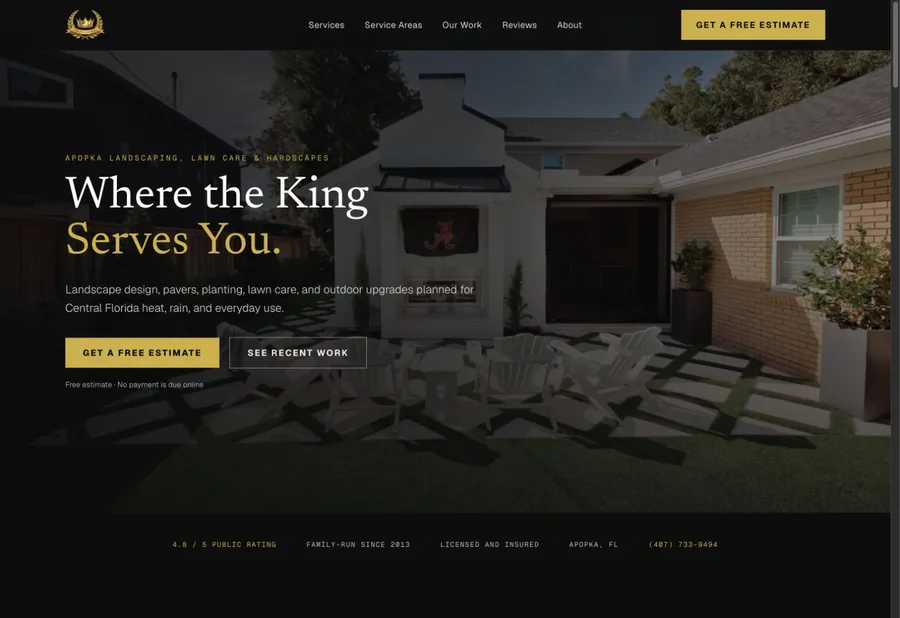
King Kutz's website connects service destinations, coverage information, project work and estimate requests. Its walkthrough makes the structure visible. The example supports those website decisions; it does not establish that every business needs the same page count.
Start with the work
Outdoor projects establish the quality and range of the business before a homeowner starts comparing services.
A live service-business website connecting projects, service information, public review sources, and estimate requests. Historical search evidence is documented below; it is not a claim about current lead volume.
See the workBring the coverage you can support.
Best fit
- businesses serving multiple cities
- contractors with regional coverage
- landscapers expanding markets
- service brands with county coverage
- teams with weak local pages
Bring the coverage you can support.
- The cities or regions your team actually serves, with any coverage limits.
- Priority services and genuine project information available for those areas.
- Your current area pages and any search reports for them.
What business owners usually want to know.
Do we need a page for every city we serve?
No. Start with the customer need and information you can support. An existing service page or area hub may be sufficient. Separate pages need a useful purpose beyond another city name.
Can local pages share the same layout?
Yes. A consistent layout helps people navigate. The page still needs relevant service and coverage information; changing names in repeated paragraphs is not a content strategy.
What if we do not have projects to show in every area?
We do not invent them. Confirmed service coverage and useful information may still help, but limited supporting detail can be a reason to use a broader page instead of another location page.
Can you improve existing service-area pages?
Yes. We review their purpose, links and available search evidence before recommending edits. Consolidation or redirects, when appropriate, require a separate plan. Scope and pricing follow review.
Let’s choose the areas worth building around.
Share your current pages, actual coverage and priority services. Jan replies within 48 hours with the next step. Page scope and pricing follow review.